October 12, 2026
Why Employee Resistance Is the Real Barrier to AI Adoption in Companies
AI adoption stalls on people, not tools. Why employees resist AI, why they're often right, and how to deploy AI that augments your team instead of replacing it.
- AI adoption challenges
- change management
- shadow AI
Every week I talk to leaders who tell me the same story. They bought AI licenses for the whole team. They ran a pilot. Six months later, a handful of people use it to rewrite emails and everyone else has quietly gone back to the old way.
Their conclusion is usually: “The tool isn’t ready.”
My conclusion is different. The tool was never the bottleneck. The rollout ignored the people who were supposed to use it.
The tool isn’t the bottleneck
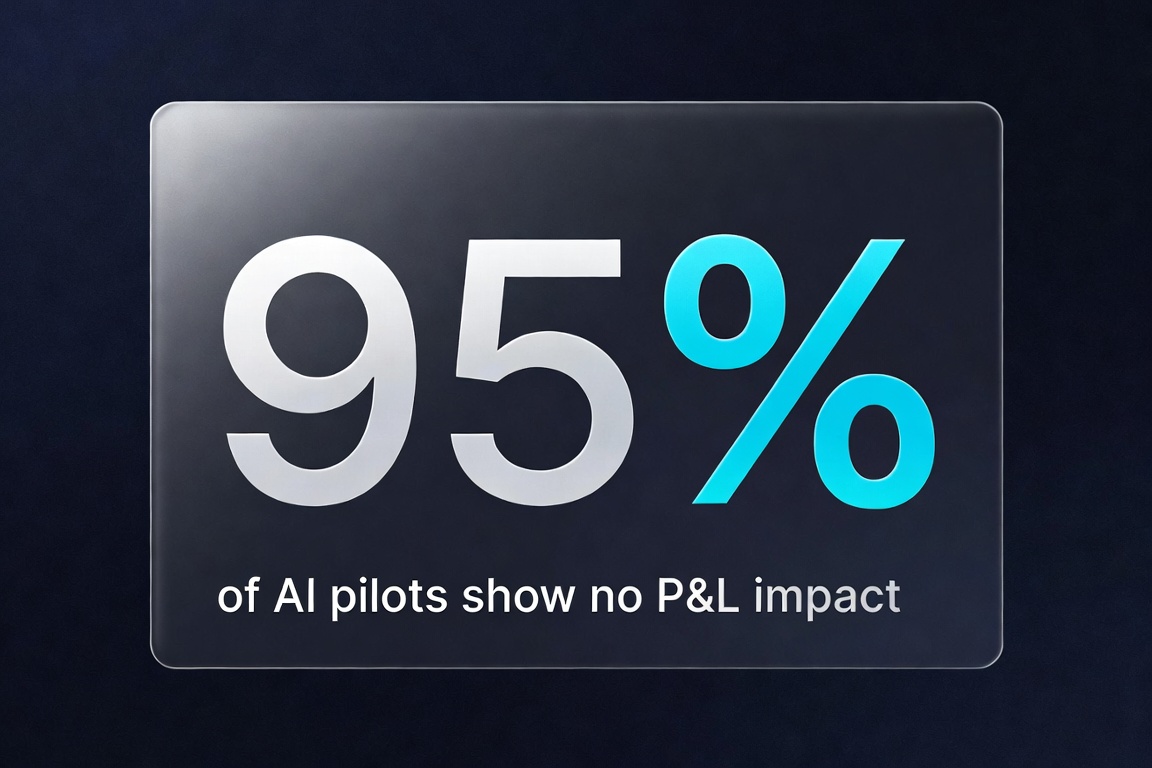
MIT’s 2025 research on enterprise generative AI found that about 95% of pilots delivered no measurable impact on profit and loss. The same research found that workers at most companies use personal AI tools on their own, often more than the official ones.
Read those two findings together. People aren’t against AI. They’re against the way AI is being handed to them.
Excellent tools that don’t address your company’s real bottleneck will only ever produce marginal output. You can put a Formula 1 engine in a car with flat tires and it still won’t win.
Why employees resist AI (and why they’re often right)
When I dig into stalled AI adoption, the same five reasons come up again and again.
- Fear of replacement. If leadership talks about AI as headcount reduction, don’t be surprised when your team doesn’t help you build it.
- Fear of surveillance. An AI tool that logs everything feels like a performance monitor. People change their behavior when they feel watched, usually by using the tool less.
- Fear of leaking data and taking the blame. An accountant who pastes a client’s balance sheet into a cloud chatbot knows exactly who gets fired if it goes wrong. So they don’t paste it, and the tool stays shallow.
- The workflow tax. Most AI gets bolted on top of existing work: another tab, another login, another thing to check. It adds work before it removes any.
- Nobody asked. Most AI rollouts start from what the tool can do. Very few start from what is actually slowing the team down.
None of those are irrational. They’re signals.
Resistance is data
Here’s the shift I want leaders to make: stop treating resistance as a change-management problem to overcome. Treat it as a map. Where your team pushes back tells you where the rollout is wrong. If people won’t use AI on client files, you have a privacy problem. If they ignore it during crunch time, it isn’t in their workflow. If senior staff are the most skeptical, you probably haven’t shown them how it protects their judgment instead of replacing it.
The companies that get AI adoption right don’t push harder. They listen first.
Humans aren’t being replaced. They’re being unblocked.
Take our first vertical: accounting firms.
During closing season, a chartered accountant’s week is eaten by work that isn’t really accounting: chasing clients for missing documents, matching bank lines, reformatting exports, answering the same five questions by email. That’s where the hours go, and that’s where AI shines. What AI can’t do is sign the accounts. It can’t carry professional liability, read the room with a nervous client, or decide what “reasonable” means in a gray area. Accountability can’t be delegated to a model. So the right design isn’t “AI does the accountant’s job.” It’s “AI does the chasing, the human keeps the judgment.” The expert becomes more of an expert, because they finally have time to be one.
That’s true well beyond accounting. In every industry we look at, the most valuable part of the job is the part only a human can own. AI’s role is to clear everything standing in front of it.
How we approach AI adoption at Sceptra
We built our process around that belief.
1. Onboarding starts with your pain points, not our features. Before we deploy anything, we sit with your team. Where do the hours actually go? What gets done twice? What does everyone dread on Monday morning? The answers are rarely what leadership expects.
2. Then we deploy on-premise, with views and controls. Sceptra runs inside your infrastructure. Your team can see what the AI is doing and why. Managers decide what it can access, space by space. There’s no black box and nothing is hidden from the people it’s supposed to help.
3. Privacy and values stay inside your network. When data never leaves your premises, your people stop worrying about what they’re allowed to paste. That fear was one of the biggest drags on adoption, and it disappears once the data stays home.
We’re not selling you “an AI that replaces staff.” We’re giving your staff an AI they trust enough to actually use.
A 5-step playbook for leaders
- Map the bottleneck before you pick the tool. Interview the people doing the work. Find the three tasks that burn the most hours for the least value.
- Say out loud what AI will not do. Tell your team explicitly which decisions stay human. Ambiguity breeds fear.
- Solve privacy first. If your team can’t safely use AI on real data, it will only ever touch trivial work.
- Put AI inside the workflow, not on top of it. If it takes an extra tab to use, most people won’t.
- Measure time given back, not licenses activated. Adoption dashboards lie. Hours returned to meaningful work don’t.
The bottom line
AI adoption doesn’t fail because people are afraid of the future. It fails because nobody asked them about the present.
Find the real bottleneck. Protect what matters. Keep humans where they belong: in charge.
Your context. Your models. Your values.
Source: MIT NANDA, “The GenAI Divide: State of AI in Business 2025” (Aug 2025).